
In the name of God, the Merciful, the Mercy Giver
In His profound mercy, God gives us moments in life that invite us to slow down, reflect, and return to Him.
One way I have come to reflect on this devotion is through the very movements of our prayer.
In qiyam, we stand upright, alert, answering the call to worship. The body rises to attention, the mind engaged, the intention set.
In ruku, we bow, lowering ourselves, bringing the head level with the heart – a reminder that faith requires humility, balance, and submission – not intellect alone, but the heart as well.
And in sujood, with our head on the ground, fully beneath our heart, the body declares reverence to God in complete surrender.
The Prophet Muhammad ﷺ reminded us of this when he said:
The servant is closest to his Lord during sujood, so increase your du’a therein.
Before I was invited by God to perform Hajj in 2025, I was personally struggling with something that I imagine some of you may feel as well – that my prayers often felt rushed.
In my prayers, I spoke to God – but I rarely sat with Him.
And this isn’t just a personal feeling – God reminds us in the Qur’an (23:1-2):
Successful indeed are the believers – those who, in their prayers, humble themselves.
I mention Hajj not as the center of this experience, but as one of many doors that led me to the realization that I wanted something better for myself – for growth and for connection.
When my friends performed Hajj, they often shared how challenging it was – too hot, too crowded, or both – to feel a deep spiritual connection despite completing all its rituals.
I, too, shared this concern.
Months before Hajj, we began taking classes that covered every aspect of the journey – logistics, rituals, expectations. And in our very first class, the imam said something that stayed with me. He said:
“Hajj is a test. It is filled with anxiety, discomfort, disruption, and fatigue. Your job is not to avoid these tests – but to expect them. To be patient when they come, and to adjust your attitude when things don’t go as planned.”
Then he said something even more striking.
“In short, try to find connection through the distractions – and set your mentality to serve one another – because that is exactly how life in this Dunya works.”
In that moment, I realized Hajj was not separate from life.
It was life – concentrated and intense.
And when we are unintentionally consumed by the distractions of this world, we need to intentionally find connection – through our words and through our deeds.
This does not require us to withdraw from the world.
But it does require moments of return – moments that purify the heart and realign it with what truly matters in the sight of God.
As part of our Hajj preparation, we were reminded that the Prophet ﷺ strongly encouraged pilgrims to settle worldly affairs beforehand: to clear debts, to seek forgiveness from people we had wronged, and to leave behind unnecessary burdens.
And, like many pilgrims, we were encouraged to collect du’a requests from others – to carry their prayers with us to Arafah.
I was humbled by the number of intimate and heartfelt pleas I was entrusted with.
And I was equally humbled by the number of people who wanted me to pray for them, yet didn’t know what to pray for.
That moment brought me face to face with something deeper.
It wasn’t a lack of faith. It wasn’t carelessness.
It was something many of us quietly struggle with.
Even when we make time to sit with God…we don’t always know what to talk about.
So, I began asking myself a simple question: What truly matters to my heart – and how do I place that, humbly, before God?
The Prophet ﷺ said, “Hajj is Arafah” – highlighting a moment where, when done purposefully, all distractions fall away and the servant stands alone with the Lord.
And whereas Arafah is a specific time and place, the state it represents is something every believer can taste.
When I was younger, my understanding of Hajj and Arafah was shaped by simple images – of a pilgrim standing on a quiet hill, wrapped in ihram, tears flowing, hands lifted toward God in words of gratitude and in search of forgiveness.
Today, the reality looks different. Nearly two million pilgrims gather in an organized city of tents and pathways. But despite the changes in setting, the heart of Arafah remains the same. The prayers are still whispered. The tears are still sincere. And God’s Mercy still descends.
Precisely because of this reality – because of the crowds and the many distractions – we were encouraged to be intentional about our dua before arriving at Arafah.
While the most powerful du’a is what comes from the heart, it was wise of us to reflect beforehand, to jot down an outline of what we hoped to say, and to remember the names of those we wanted to carry with us in prayer.
On the 9th of Dhul Hijjah, in the six hours or so from Dhuhr to sunset, pilgrims are encouraged to take full advantage of what may be a once-in-a-lifetime moment – to make du’a continuously – when God tells the angels to look at His servants, full of hope, asking for His Mercy.
Because Arafah is not about movement. It is not about crowds.
It is about standing before God. Asking. Pleading. Hoping.
No distractions. No idle chatter. No performance.
Just a servant before his Lord.
God describes this state so beautifully in the Qur’an (7:205):
Remember your Lord inwardly with humility and reverence and in a moderate tone of voice, morning and evening, and do not be among the heedless.
In Arafah, Alhamdulillah, I kept my promise – supplicating each person’s du’a, word for word, before God.
And for those who didn’t know what to pray for, I prepared a du’a – one that came from the heart – for them and for me. Simple enough to remember, yet meaningful enough to help me sit with God and speak to Him – just as I now try to do in my daily prayers.
That day on Arafah, despite the scorching heat, I stepped outside our tent and found a small patch of shade beneath a eucalyptus tree. Wrapped in my ihram, with tears in my eyes and hands lifted toward God, I whispered my du’a quietly – inward, not public – just as we are encouraged to do.
Afterward, when I returned to our tent, I found a quiet place, took a sip of water, and turned to God with the long outline of the many du’a I prepared at home.
Although I was one of millions, this time felt private and exclusive. This was the beautiful paradox of Arafah: I was in the biggest crowd of my life – millions of people gathered in a single place at a single time – yet, it was also where I found solitude, just a servant before his Lord. Alhamdulillah, I felt I got the best of both worlds expressed in the Hadith Qudsi as reported by Abu Hurairah:
The Prophet ﷺ said, “Allah the Exalted says: ‘I am as my servant expects me to be, and I am with him when he remembers Me. If he remembers Me inwardly, I will remember him inwardly, and if he remembers Me in an assembly, I will remember him in a better assembly’ (i.e. in the assembly of angels).”
I was remembering God inwardly, and doing so in the best company – united with the pilgrims who had journeyed for the same purpose.
And in that time of solitude – asking, pleading, hoping, from my heart – hours passed like seconds. And all I could say was Alhamdulillah.
Upon reflection of this experience, I realized something simple – but profound.
God was not waiting for eloquence. He was not asking for perfectly crafted words.
He was asking for honesty. For presence. For a heart willing to turn toward Him.
And moments like those – prostrating with nothing but need – are not limited to Arafah.
It is available to every one of us.
In every prayer.
In every sujood.
Whenever we choose to slow down… and sit with God.
Truly, it is in the remembrance of God that hearts find peace. (Qur'an 13:28).
# # #
Note: I’ve written these words first and foremost as a reminder to myself – and I ask God to allow them to be of benefit to all of us. I ask forgiveness for any mistakes I may have made.
# # #
Below is the du’a (supplication) that I prayed while outside our tent in Arafah. It was written with much help from my brother-in-law, Khalid. May our Creator be pleased with him.
Our Most Loving and Most Merciful Creator, the One nearest to our hearts.
You know what is in our hearts before we speak it. You see every struggle, every hope, every silent prayer we make for those we love.
Our Lord, we lift up to You our family, our friends, and our community. Wrap them in Your infinite mercy. Shield them with Your protection. Forgive their mistakes — the ones they know and the ones they don’t.
Guide their hearts gently but firmly to Your light. Keep them steadfast on the straight path, even when the world pulls them in every other direction.
Grant them peace in their minds, strength in their bodies, clarity in their hearts, and stability in their lives. Heal their wounds — the visible and the hidden. Lift their burdens and replace them with ease, and let them feel Your presence in every moment of despair or joy.
Bless them with wisdom to know truth from falsehood, and the courage to follow what is right, even when it’s hard. Let their lives be a means of goodness and light.
And if ever they feel lost, bring them back to You — gently, lovingly, completely.
Make their faith deep, their intentions pure, their deeds accepted, and their hearts always turning toward You.
Continue to guide, protect, and shower us with Your mercy, grant us goodness in this life and the next, and save us from the torment of the hellfire.
Let us reunite with joy in the next life, under Your shade, in the company of those You love.
Ameen.
# # #
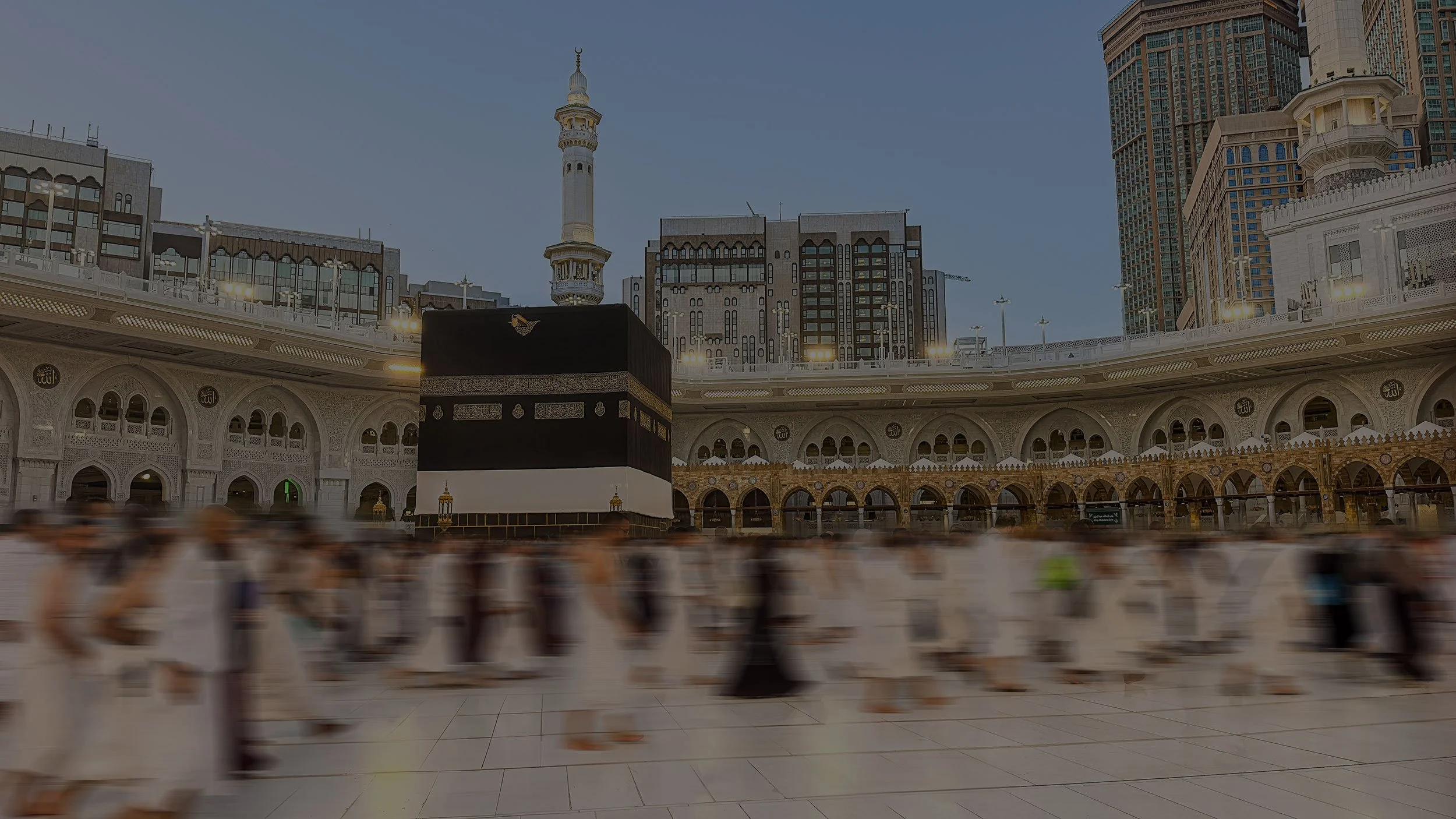
Blog cover photo “Hajj in Motion” by Tarik Trad